Global News | November 11, 2026
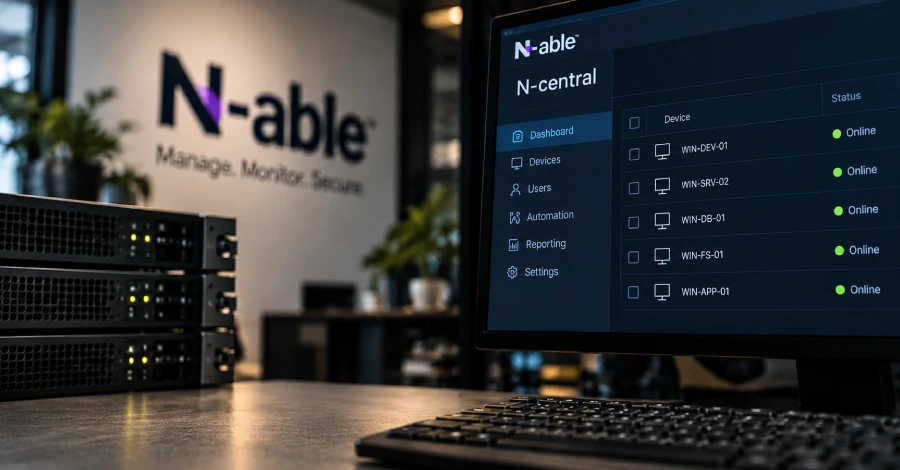
The N-able N-central vulnerabilities prompted the software provider to take its hosted remote-management environment offline after a researcher publicly disclosed more than 30 alleged security flaws. The disclosure, known as Able2Shell, includes proof-of-concept material describing potential ways to compromise the server that managed service providers use to administer customer systems.
N-able said the shutdown was precautionary and advised customers operating on-premises N-central servers to take them offline until further guidance. In its November 9 statement, the company said it had not observed active exploitation of the newly disclosed issues and was working on remediation.
The N-able N-central vulnerabilities raise concerns because remote monitoring and management platforms can have privileged connections to many devices. A weakness in a central management server may therefore have consequences beyond the server itself. That potential impact is not evidence that any customer was compromised or that attackers used Able2Shell against a production environment.
The situation can change quickly. The information in this article is limited to the November 9 reporting available for this historical account. Customers should check N-able’s current incident and release guidance before deciding when to restore systems.
What Happened to N-able N-central?
N-central is a remote monitoring and management platform used by managed service providers, or MSPs, and internal IT teams. Such platforms help administrators monitor devices, manage software, apply updates and provide remote support across customer environments.
On November 9, N-able said it had taken its hosted N-central environments offline as a precaution after critical vulnerabilities were publicly disclosed. The company advised customers who run N-central on their own premises to take those servers offline temporarily while it worked on remediation.
The N-able N-central vulnerabilities were disclosed by security researcher Sean Bales, who published technical material and proof-of-concept code under the Able2Shell name. BleepingComputer reported that the researcher described more than 30 alleged flaws; security firm Field Effect described 33 reported issues. BleepingComputer said it had not independently verified every reported vulnerability.
A public proof of concept is material intended to demonstrate a technical issue. Its publication can increase urgency, but it does not establish that every claimed flaw affects every version or that the code has successfully been used against a customer. N-able’s precautionary response confirms that the company regarded the disclosure as serious; it does not independently validate every detail in the researcher’s repository.
Timeline of the Disclosure and Response
BleepingComputer reported that Bales disclosed the N-able N-central vulnerabilities late on November 8 and published an Able2Shell repository containing proof-of-concept material. The timing reflects the report’s account; public sources may describe dates differently because they use different time zones.
On November 9, N-able took its hosted N-central environments offline across the Americas, Europe and Asia-Pacific, according to the company statement reported by BleepingComputer. It also provided guidance to on-premises customers to temporarily shut down their servers.
In the same statement, N-able said its security, engineering and operations teams were working on remediation and that it had not observed active exploitation. BleepingComputer subsequently reported that the company was developing and validating a hotfix and had found no evidence of active exploitation or unauthorized data access at that point.
The distinction between a public exploit demonstration and an attack against an actual customer is important. N-able’s statement describes what it had observed at that time; it is not a guarantee that exploitation could never occur, nor a substitute for checking later updates.
What the Researcher Reported
The researcher described the N-able N-central vulnerabilities as a collection of issues across the N-central server application. According to BleepingComputer and Field Effect, the disclosures include alleged authentication bypasses, credential exposure, file-handling weaknesses and other flaws that may be combined into exploit chains.
BleepingComputer reported that one chain described by the researcher begins with an unauthenticated XML external entity issue and can lead to commands running on the server. The publication also reported a demonstration involving the creation of an administrator account. These are researcher-described capabilities, not confirmed actions in an attack against an N-able customer.
The researcher said testing was conducted against N-central Appliance version 2026.4.0.31 and believed earlier versions could also be affected. That belief is not a complete vendor-confirmed affected-version matrix. Administrators should use N-able’s current guidance to assess their specific deployments rather than assume that an unlisted version is safe.
The N-able N-central vulnerabilities should also be distinguished from earlier N-central security incidents. A previous fix for a different vulnerability does not, on its own, establish protection against the newly disclosed Able2Shell issues.
Seven Critical Risks for MSPs and Their Customers
The following are potential consequences of a successful compromise of a remote-management server. They should not be read as evidence that these outcomes occurred in the Able2Shell disclosure.
- Unauthorized server control: The researcher described exploit chains that could allow commands to run on an N-central server. If validated and successfully exploited in a specific environment, such access could undermine the management system itself.
- Administrator account abuse: BleepingComputer reported a demonstration in which an administrator account was created. An unexpected account or privilege change could provide a route for further access and warrants investigation.
- Exposure of stored credentials: Remote-management platforms can hold credentials or integration details used to administer connected environments. Whether a particular secret is exposed depends on the deployment and the access an attacker actually obtained.
- Unauthorized actions on managed devices: An RMM system is designed to carry out legitimate administrative tasks remotely. If an attacker gains sufficient control, those capabilities could potentially be misused against managed devices. No such downstream activity is established by N-able’s November 9 statement.
- Loss of visibility during an outage: Taking a management platform offline can interrupt normal monitoring, patching or remote-support workflows. The impact varies by service and by the alternative tools available to the MSP and its customers.
- Potential persistence after recovery: Applying a future fix would address the vulnerabilities it covers, but it would not automatically prove that pre-existing unauthorized accounts, credentials or configuration changes had been removed. Investigation is separate from patching.
- Broader customer and business impact: A provider may manage systems for many organizations. A confirmed compromise could require coordination across customers, service owners and response teams. The actual scope would depend on evidence and the permissions available in the affected environment.
The N-able N-central vulnerabilities illustrate why organizations must assess both software exposure and the authority of the platform on which that software runs. Neither the number of disclosed issues nor the potential reach of an RMM tool establishes the number of affected customers.
What N-able Has Said and What Remains Unknown
N-able described the hosted shutdown as a precaution and said it was working on remediation. It told BleepingComputer that it had not observed active exploitation of the vulnerabilities at the time of its November 9 statement.
BleepingComputer reported that some Ecoverse services accessed through N-able Login remained operational while the N-central classic environment was unavailable. Organizations should verify the current availability of the specific services they use rather than assume that every N-able product was taken offline.
Several questions remained unresolved in the November 9 reporting:
- Which specific N-central versions and configurations are affected by each reported issue?
- Which individual findings and chains have been independently validated?
- When will N-able issue remediation and restoration instructions?
- Will investigation identify attempts against customer environments?
- What logs or other indicators can administrators use to assess past exposure?
The company’s statement that it had not observed exploitation is time-bound. New findings, updated guidance or a released fix could materially change the response. Organizations should rely on the latest vendor instructions rather than a historical snapshot.
What MSPs and IT Teams Should Do
For the November 9 response, N-able’s reported guidance was to take on-premises N-central servers offline and keep them offline until the company provided further direction. Hosted customers were affected by the provider’s precautionary shutdown. Before restoring any system, administrators should consult the current incident page and follow the latest vendor instructions.
Organizations should identify all N-central deployments, including production, backup and test instances. MSPs should establish which customers and devices depend on each management server and document the alternative processes needed for urgent support, monitoring and patching.
The N-able N-central vulnerabilities also warrant a review of available evidence. Huntress recommended examining login and authentication activity from November 8 onward for unexpected access. Teams can also review administrator accounts, remote-support activity, scripts and configuration changes where records exist. These are investigation leads, not indicators that any particular customer has been compromised.
Preserve relevant logs and coordinate with incident responders before making changes that could destroy evidence. If suspicious activity is found, assess the N-central server and the customer environments it could administer. Review the permissions and credentials available to that server, and rotate potentially exposed credentials as appropriate to the confirmed scope.
A lack of suspicious entries does not prove no access occurred if logging or retention was incomplete. Equally, an outage or the presence of a vulnerable version does not prove that an attacker accessed a system.
The Disclosure Dispute and Wider Security Lessons
Bales told BleepingComputer that he released the Able2Shell material without notifying N-able beforehand because of concerns about how the company handled earlier reports involving a different product. Those allegations concern separate issues, not the N-central findings in this disclosure.
BleepingComputer said it asked N-able about the researcher’s earlier allegations, but the company did not address those questions in its response to the publication. They should therefore be presented as the researcher’s account rather than as independently established findings.
The disagreement also does not change the immediate need to protect customer environments. Publicly available proof-of-concept material, a vendor-directed shutdown and uncertainty over affected versions create a fast-moving operational challenge for MSPs.
More broadly, the N-able N-central vulnerabilities highlight the security responsibilities attached to management tools. Organizations benefit from centralized administration, but that centralization can also make a management server a high-value target. Restricting administrative access, maintaining inventories, retaining useful logs and planning alternative support processes can help teams respond when a critical platform must be taken offline.
These measures are general risk-reduction practices. They should not be described as a vendor-approved substitute for the specific N-able fix or restoration instructions.

Conclusion
N-able took its hosted N-central environment offline after the Able2Shell disclosure and advised on-premises customers to temporarily shut down their servers. As of the company’s November 9 statement, it had not observed active exploitation of the newly disclosed issues.
The reported vulnerabilities could present serious risks because N-central manages other systems, but the full affected-version range and any actual customer compromise were not established in the November 9 reporting. MSPs should follow current vendor guidance, preserve evidence and investigate suspicious activity before returning affected services to normal operation.
Source note: This historical account draws on N-able’s statements reported by BleepingComputer, the researcher’s public disclosure, and analysis by Field Effect and Huntress. Claims about the number, mechanisms and affected versions of the reported flaws are attributed to their sources. The account is limited to November 9 information and requires a current vendor-status check before publication.
NewsFlayer — Bringing You the Latest Cybersecurity News from Around the World.