
France | November 16, 2026
The Maileva data breach has exposed the names and postal addresses of 22 million people whose correspondence passed through a business mailing service in France, according to reporting that quotes the company and its parent group.
Maileva, a Docaposte service within the La Poste group, helps organizations prepare and send professional correspondence. The people affected were recipients of customers’ mail, not necessarily direct users of Maileva. A single supplier incident can therefore reach far beyond the businesses with which it has contracts.
In a written response to Cyberattaque.org’s investigation, Maileva confirmed that 22 million people were affected by the theft of their first names, surnames and postal addresses. It also said several thousand client companies were concerned.
La Poste subsequently confirmed the figure to Agence France-Presse, according to France 24. The group said Maileva notified France’s data protection authority, the CNIL, and filed a complaint. A judicial investigation is under way.
The scale is striking, but the confirmed figure needs careful interpretation. It does not establish that attackers obtained the complete contents of every letter associated with the 22 million people. Nor does it mean that each individual’s bank details, medical records or passwords were stolen.
Maileva data breach reaches beyond direct customers
Many people may not recognize the Maileva name. That is because the service operates behind the scenes for businesses and other organizations that need to send letters to customers, patients, tenants or other recipients.
An organization can prepare correspondence and rely on a specialist provider for some combination of processing, printing and dispatch. In that arrangement, the recipient may know the sender but have no direct relationship with the mailing platform.
That distinction matters when a breach occurs. A person can be affected without ever opening an account with the compromised provider or handing their details to it directly. The relevant connection may be a letter from a hospital, housing organization or another institution.
Cyberattaque.org’s investigation describes notifications involving several customer sectors, including social housing and health. These reports show why the same underlying incident can generate many separate notices, each describing a different group of people and a different set of potentially exposed details.
The Maileva data breach also illustrates a common third-party risk: an organization can experience an exposure through a service provider even when its own systems were not directly compromised. A provider may serve thousands of customers, making the downstream impact much larger than the number of organizations directly contracted with it.
Names and addresses are the confirmed core
The company-confirmed figure concerns first names, surnames and postal addresses. Those details can be used in more convincing impersonation attempts because they help a fraudster make contact appear familiar and relevant.
They are not, by themselves, proof that all related records contained financial or medical data. The public reporting distinguishes the broad 22 million figure from information that might be involved in specific customers’ correspondence or workflows.
Cyberattaque.org reported that internal documents it obtained referred to roughly 39 million mail references, corresponding to about 22 million distinct people after deduplication. That explanation comes from the outlet’s reporting on documents attributed to Docaposte; it should not be interpreted as 39 million different victims.
The same person could be connected to multiple items of mail or multiple sending organizations. The distinction between a mail reference and a person is important when assessing the scale of a shared mailing platform.
For an individual recipient, the most useful source of detail is a notification from the organization that sent the correspondence. The sender should be able to explain which categories of that person’s information were involved, subject to the findings of its investigation.
Different notices may describe different exposure
Some customer communications have described information beyond a name and address. Cyberattaque.org reports notices involving housing and healthcare-related correspondence, while other coverage describes items such as invoice details and dates of care in particular contexts.
These details should not be generalized to everyone in the 22 million figure. Their significance depends on the relevant customer, the documents processed and what the investigation established about access.
Reporting also describes a possible separate exposure involving a billing tool and information about business clients. That is distinct from a claim that the bank details of all individual mail recipients were stolen. Public reporting is not consistent enough to establish every field and every affected group as a universal outcome.
If you receive an official notice, read the categories it identifies and whether they are described as accessed, potentially exposed or confirmed stolen. Those terms are not interchangeable. Preserve the notice and contact the sender through an independently verified channel if the scope is unclear.
A timeline from disruption to disclosure
La Poste told AFP that the incident took place in mid-September. Cyberattaque.org reports that Maileva suspended its services on September 23 after detecting suspicious activity.
Initial communications described unauthorized access attempts involving customer accounts and fraudulent mailings. Later notifications from affected organizations indicated that a mail-tracking database had also been accessed, according to the investigation.
On November 13, Cyberattaque.org published Maileva’s written confirmation of the 22 million figure. On November 14, La Poste confirmed the exposure to AFP, according to France 24. Subsequent reports described the opening of a criminal investigation.
The gap between an incident, individual customer notifications and a later public estimate is an important context. It does not, on its own, establish when any particular organization learned the full scope or whether its notification complied with applicable deadlines.
The public record described in these reports also leaves unanswered questions about the precise initial access method, the complete extent of extraction and the identity of the attacker. Speculation should not replace verified findings.

Why the Maileva data breach creates fraud risks
A name and postal address can make an unsolicited message appear more credible, particularly when the message imitates an organization the recipient already knows. A fraudster might refer to a tenant account, an unpaid bill or a delivery problem and attempt to create urgency.
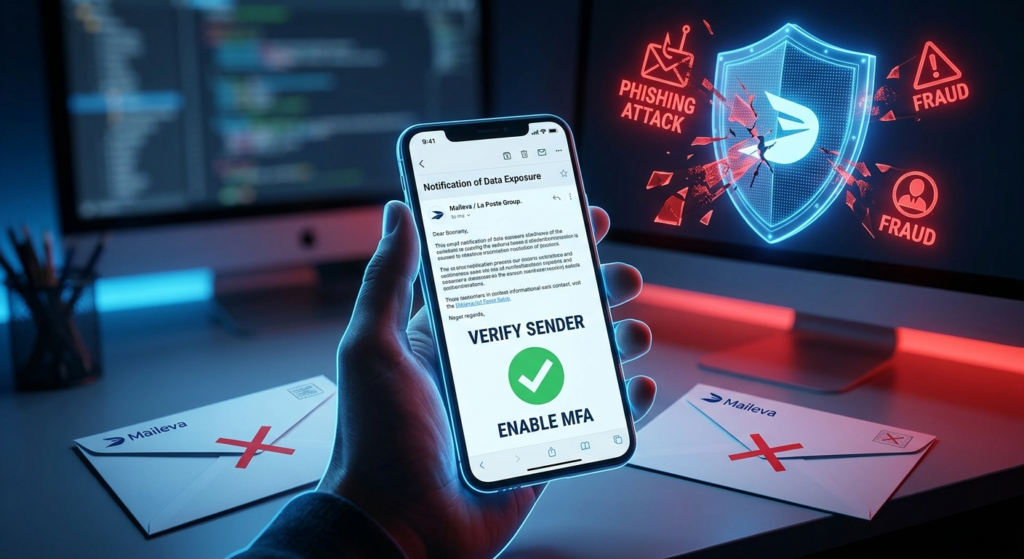
The Maileva data breach could support several types of social engineering. Possible scenarios include fraudulent letters, emails or telephone calls impersonating a housing provider, healthcare organization or postal service. These are potential risks, not evidence that a specific campaign has occurred.
A recipient might be directed to a fake payment page or asked to provide further information to “verify” an account. In another scenario, a caller could use a real address as a trust signal before requesting a password or one-time code.
Criminals can also combine data from unrelated sources. A postal address alone does not prove that an attacker has a person’s email address or phone number, but information obtained elsewhere could be used to enrich a fraudulent approach.
The safest response is to treat unexpected demands with caution even when the sender appears to know genuine personal details. Familiar information is not proof that a request is legitimate.
Practical steps for affected individuals
If an organization informs you that your data was involved, check the exact categories and follow any specific steps in its notice. Confirm the notice through a phone number or website you already trust rather than through a link or number included in a suspicious message.
Be cautious of urgent payment demands, requests to change bank details and messages claiming that immediate action is needed to avoid a penalty. Visit the organization’s official website directly or contact its established support team before paying.
Do not share passwords, one-time verification codes or full payment credentials in response to unexpected calls or messages. A legitimate organization’s name, logo or knowledge of your address does not authenticate the request.
If a notice says credentials were exposed, change the affected password and any reused passwords, and enable multifactor authentication where available. Names and postal addresses cannot simply be reset, so changing a password is not a remedy for address exposure alone.
If you suspect you have paid a fraudulent invoice or disclosed banking details, contact your bank promptly using a verified number and follow its fraud-reporting process. Keep copies of messages, envelopes and transaction records where safe to do so.
You can also ask the organization that sent you the notice which information was involved, what support it offers and how to contact its data protection officer. Avoid sending additional sensitive information until you have verified the communication channel.
What organizations should do
Organizations that use mailing, printing or document-management suppliers should identify which services process recipient data and which subcontractors may have access. A contract with one provider can conceal a longer processing chain.
Review what data is sent, why it is needed and how long it is retained. Where possible, avoid embedding unnecessary personal details in file names or tracking metadata. Data minimization reduces the information at risk if a shared service is compromised.
Incident-response plans should account for supplier incidents as well as intrusions into internal networks. Assign responsibility for gathering facts, assessing affected populations, coordinating with suppliers and deciding when customers or regulators must be notified.
Finance teams should independently verify changes to supplier bank accounts using a known contact method. Staff should not rely on the phone number, link or email address in the same message requesting the change.
A related NewsFlayer report on the Arara message data breach examines another service-provider incident. It is a separate case, not evidence that Arara was connected to Maileva.
Privacy duties and open questions
La Poste said Maileva notified the CNIL and informed affected business customers, according to the cited reporting. Depending on the processing arrangement, those customers may have their own responsibilities to assess risk and inform affected individuals.
Notification duties under the EU General Data Protection Regulation depend on the facts, including the roles of the parties and the risk to individuals. The existence of a notification does not by itself establish a regulatory finding or a penalty.
Important questions remain about the attack path, the information accessed in individual customer environments and whether investigators will publish further findings. Readers should rely on direct communications from their organizations and updates from relevant authorities for their own circumstances.
The Maileva data breach is a reminder that ordinary contact details can carry real security value when collected at scale. The confirmed 22 million figure is substantial, but the responsible interpretation remains precise: it concerns names and addresses, while the exposure associated with individual organizations may differ.
Sources: Cyberattaque.org; France 24 / Agence France-Presse; La Poste and Maileva statements as quoted in those reports.
NewsFlayer — Bringing You the Latest Cybersecurity News from Around the World.