
Microsoft Global Outage: 7 Shocking & Critical Facts After Recovery
The Microsoft Global Outage that paralyzed government ministries, hospitals, courts, airlines, and enterprises across more than 70 countries and territories has finally been fully resolved, Microsoft confirmed on Saturday, November 14, 2026. Stretching across roughly 24 to 36 hours from Thursday midday in the United States through Friday and early Saturday, one of the worst cloud communications failures in recent history knocked out critical Microsoft 365 services—including Outlook, Microsoft Teams, Exchange Online, and the Copilot AI assistant—for a massive portion of the company’s 450 million+ commercial subscribers.
From NHS England hospitals reverting to paper charts and British Crown Courts scrambling to find working 1990s fax machines, to disrupted intelligence agencies in Australia and grounded customer support systems at Indian and Asian airlines, the incident exposed the extreme fragility of global cloud monoculture. In this comprehensive post-mortem guide, we will break down the 7 critical facts of the Microsoft Global Outage, the exact network capacity upgrade bug that caused it, SLA downtime math, and how Pakistani banks and IT exporters can build multi-cloud resilience.
Table of Contents
- H1: Inside the 24-Hour Microsoft Global Outage: What Triggered the Collapse?
- H1: 7 Shocking Facts About How the Outage Paralyzed 70+ Countries
- H1: Cloud SLA Math & Global Disruption Impact Matrix (Table)
- H1: The Cloud Monoculture Risk: Why Governments Are Questioning Big Tech
- H1: National Impact: Lessons from the Microsoft Global Outage for Pakistan’s IT & Banking Sector
1. Inside the 24-Hour Microsoft Global Outage: What Triggered the Collapse?
When Outlook inboxes, Teams video calls, and Copilot enterprise chats suddenly froze at midday Thursday (US time) / 6:00 p.m. (UK time) on November 12–13, 2026, initial fears across cybersecurity command centers pointed toward a coordinated state-sponsored cyberattack or a rogue autonomous AI agent.
However, as Microsoft engineers worked around the clock to reroute traffic and roll back configurations—announcing full restoration on Saturday, November 14, as reported by The Guardian and Al Jazeera Technology—the $3.8 trillion Redmond tech giant confirmed that the culprit was entirely internal:
- Not a Cyberattack or AI Agent: Microsoft explicitly apologized and clarified that the Microsoft Global Outage was “not related to cyber” or artificial intelligence agents.
- Latent Network Capacity Upgrade Bug: According to Microsoft’s official root-cause summary, the cascading failure “was introduced by an issue during an earlier network capacity upgrade that surfaced” only after a subsequent routine network configuration change was pushed live across its global Wide Area Network (WAN) backbone.
When that secondary network change interacted with the latent bug from the earlier capacity upgrade, authentication and routing tables across Microsoft 365 data centers entered a cascading congestion loop, locking millions of enterprise and government tenants out of their workspaces for a full day.

2. 7 Shocking Facts About How the Outage Paralyzed 70+ Countries
According to real-time telemetry from Downdetector and government disclosures across four continents, the November 2026 Microsoft Global Outage caused surreal real-world disruptions across critical public infrastructure. Here are the seven most striking facts from the incident.
1. UK NHS Hospitals Forced Back to Pen and Paper
In the United Kingdom—where NHS England operates under a massive five-year enterprise agreement to use Microsoft 365 across trusts—vital healthcare communications were severely hit. Hospital staff were forced to revert to manual paper patient records, while health unions reported that UK ambulance services suffered a “serious impact” during the blackout.
2. British Crown Courts Scrambled to Find a Fax Machine
Britain’s already backlogged justice system ground to a halt as digital case files and prison video links failed. Several Crown Courts sent juries home early and halted prisoner transport, while staff at Minshull Street Crown Court in Manchester famously had to scramble through storage rooms to locate a working legacy fax machine to receive urgent legal documents.
3. US Congress Lost a Day of Work & Colorado Jails Halted Online Bonds
In Washington, D.C., staffers at the US House of Representatives told reporters they effectively lost an entire day of legislative work as Outlook and Teams went dark. Meanwhile, a detention facility in Colorado lost its ability to process online bond payments, forcing families to bring physical cash or money orders in person to the jail to release detainees.
4. Australian Intelligence Agency (ASIO) & Federal Police Hit
In Australia, the Microsoft Global Outage impacted local councils, courts, schools, the Australian Federal Police, and even ASIO (Australia’s national domestic security and intelligence agency). ASIO Director-General Mike Burgess confirmed that while the intelligence agency operates on multiple redundant tiers, its systems were affected “on one level, yes, but not completely.”
5. Japan & European Governments Resorted to SMS and Phone Calls
Across Europe, government ministries in France, Belgium, and the Netherlands reported widespread email blackouts, with French municipalities instructing citizens to call by telephone instead of emailing. In Japan, central government email services went offline, forcing civil servants to coordinate via SMS text messaging, while pharmaceutical giant Taisho had to process medicine orders manually by phone and shipping leader Sagawa Express lost online reservation capabilities.
6. Asian Airlines & Taiwanese Financial Firms Disrupted
In India, major carriers IndiGo and Akasa Air confirmed that their customer email support systems were knocked offline. Simultaneously, in Taiwan, securities brokerages, life insurance providers, and investment trust companies reported that fund management workflows were disrupted throughout Friday’s trading session.
7. Second Major Worldwide Microsoft Outage of 2026
This weekend’s collapse marks the second major global outage for Microsoft in 2026, reigniting intense regulatory scrutiny in London, Brussels, and Tokyo over why critical national infrastructure—from ambulances to intelligence agencies—depends on a single software vendor with 430 million to 450 million commercial users.
To see how SpaceX is building an alternative, decentralized orbital cloud infrastructure immune to terrestrial fiber routing bugs, read our feature on Orbital Data Centers (Internal Link).
3. Cloud SLA Math & Global Disruption Impact Matrix
In enterprise cloud engineering, providers promise “Four Nines” ($99.99%$) or “Five Nines” ($99.999%$) availability under their Service Level Agreements (SLAs). How does a 24-hour Microsoft Global Outage impact annual uptime math and global economic productivity?
The Monthly Uptime Percentage ($U_{%}$) and Global Economic Productivity Loss ($L_{\text{econ}}$) are calculated as:
$$U_{%} = \left( \frac{T_{\text{total_mins}} – T_{\text{downtime_mins}}}{T_{\text{total_mins}}} \right) \times 100, \qquad L_{\text{econ}} = N_{\text{impacted}} \times H_{\text{lost}} \times W_{\text{hourly}} \times \eta_{\text{dependency}}$$
In a 30-day month ($T_{\text{total_mins}} = 43,200\text{ minutes}$), a $99.99%$ SLA allows for just $4.32\text{ minutes}$ of downtime per month. A 24-hour outage ($1,440\text{ minutes}$) drops monthly availability to $96.67%$—blowing past a full year’s worth of allowable “Four Nines” downtime in a single day and triggering mandatory SLA service credit claims for enterprise customers.
| Region / Country | Key Sectors & Institutions Hit | Primary Services Disrupted | Operational Workaround Used | Current Status (Nov 15, 2026) |
|---|---|---|---|---|
| United Kingdom | NHS England Hospitals, Ambulance Trusts, Crown Courts | Outlook, Teams, Exchange | Paper charts, physical fax machines | 100% Fully Restored |
| United States | US House of Representatives, Schools, Colorado Jails | Microsoft 365, Copilot, SharePoint | Phone trees, in-person cash bail bonds | 100% Fully Restored |
| Australia | ASIO Intelligence, Federal Police, Local Councils | Government Email & Teams | Secondary classified comms channels | 100% Fully Restored |
| Japan & Taiwan | Gov Ministries, Taisho Pharma, Sagawa, Investment Firms | Exchange Online, Booking Portals | SMS text messaging, manual phone orders | 100% Fully Restored |
| India & Europe | IndiGo & Akasa Air, French/Belgian/Dutch Municipalities | Customer Support Email, Municipal IT | Call centers, alternate web portals | 100% Fully Restored |
4. The Cloud Monoculture Risk: Why Governments Are Questioning Big Tech
While Microsoft’s share price remained relatively flat on Friday (as Wall Street’s attention was simultaneously consumed by the Nvidia CEO Resignation (Internal Link)), the Microsoft Global Outage has triggered an urgent policy debate among Chief Information Officers (CIOs) and national security officials.
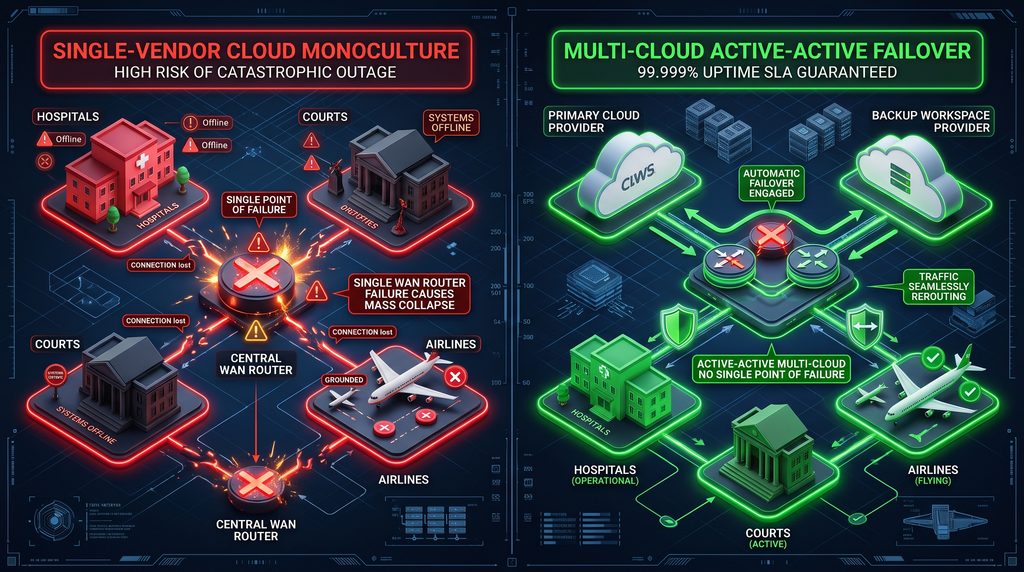
When a single company controls the email server (Exchange), the real-time chat app (Teams), the document repository (OneDrive/SharePoint), the AI assistant (Copilot), and the identity login layer (Entra ID / Azure AD), a single network upgrade bug doesn’t just break one tool—it paralyzes the organization’s ability to even communicate about the outage. During Thursday and Friday’s blackout, thousands of IT helpdesks could not email employees to tell them Outlook was down because their crisis-communication tools lived inside the exact same Microsoft 365 tenant!
To see how organizations are diversifying their AI and collaboration stacks with alternative platforms, check out our guides on ChatGPT Business (Internal Link) and the Gemini 4 Hydrogen Launch (Internal Link).
5. National Impact: Lessons from the Microsoft Global Outage for Pakistan’s IT & Banking Sector
How did the Microsoft Global Outage impact Pakistan, and what lessons must Pakistani banks, government bodies, and BPO software houses in Karachi, Lahore, Islamabad, and Faisalabad implement immediately?
Across Pakistan, commercial banks (regulated by the State Bank of Pakistan), multinational telecom operators, universities (connected via HEC’s Microsoft education licenses), and thousands of export-oriented BPO call centers rely heavily on Microsoft 365, Teams, and Azure:
- Maintain Out-of-Band Crisis Communication Channels: If your software house in Lahore or bank headquarters in Karachi uses Microsoft Teams and Outlook as its primary communication stack, a Microsoft Global Outage leaves your incident-response team blind. Every Pakistani enterprise should maintain an out-of-band emergency communication channel hosted on completely separate infrastructure (such as a self-hosted Matrix/Mattermost server, Slack, or Google Workspace fallback).
- File for Microsoft 365 SLA Service Credits: Pakistani enterprises paying thousands of dollars annually for Microsoft 365 E3/E5 or Azure subscriptions are legally entitled to financial SLA Service Credits ($25%$ to $100%$ of monthly fees for the affected service) when uptime drops below $99.9%$. IT administrators should export their tenant health logs from the Microsoft 365 Admin Center and submit a formal SLA credit claim before the billing window closes.
- Decouple DNS and Identity Authentication: Never host your primary domain’s authoritative DNS, email MX records, and emergency status page inside the exact same cloud provider. Keeping a secondary read-only backup of critical client contracts and financial spreadsheets in an independent cloud ensures business continuity when global tech giants stumble.

Conclusion: Restoration Complete, But the Wake-Up Call Remains
While Microsoft has officially restored all Microsoft 365, Outlook, Teams, and Copilot services worldwide as of November 14, 2026, the Microsoft Global Outage will be studied for years as a textbook example of cloud monoculture risk. When a routine network capacity upgrade in Redmond can force UK hospitals onto paper charts and Manchester courts onto fax machines, the message for global governments and Pakistani enterprises alike is crystal clear: cloud convenience must always be paired with independent backup resilience.
.