
Nvidia Life-After-Huang Briefing: 7 Shocking & Critical Earnings Facts
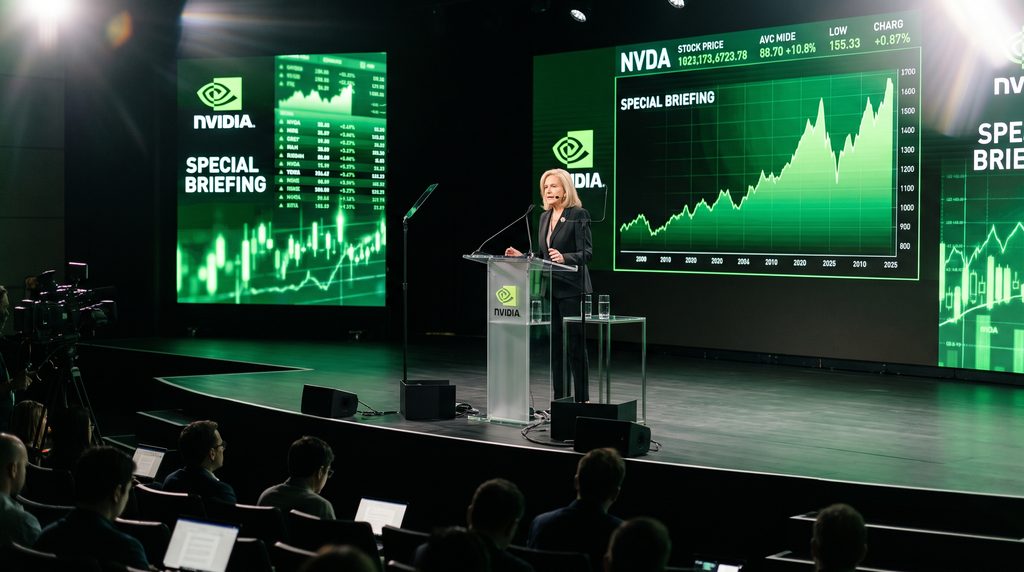
The Nvidia Life-After-Huang Briefing marks the most anticipated corporate earnings call in the history of the semiconductor industry. Scheduled for November 17, 2026—just five days after the stunning resignation of visionary co-founder and CEO Jensen Huang amid conduct and export control investigations—all eyes on Wall Street and in Silicon Valley are locked onto Interim CEO and CFO Colette Kress. As institutional investors, sovereign wealth funds, and cloud hyperscalers anxiously assess whether the world’s most valuable AI hardware titan can maintain its unbreakable CUDA software moat and staggering gross margins without its charismatic frontman, this financial briefing is set to redefine market sentiment.
In this comprehensive, in-depth analysis, we will break down the exact financial metrics of the Q3 fiscal 2027 report, the strategic roadmap for the upcoming Vera Rubin GPU architecture, Wall Street’s forward valuation multiple adjustments, and what this post-Huang transition means for enterprise buyers and Pakistan’s growing artificial intelligence ecosystem.
Table of Contents
- H1: Inside the Nvidia Life-After-Huang Briefing: Navigating Q3 FY27 Earnings
- H1: 7 Critical Facts Reshaping Nvidia Without Jensen Huang at the Helm
- H1: Supply Chain Resilience, Blackwell Ultra, and Vera Rubin Execution
- H1: Financial Guidance & Market Valuation Analysis (With Table)
- H1: National Impact: What the Nvidia Life-After-Huang Briefing Means for Pakistan
1. Inside the Nvidia Life-After-Huang Briefing: Navigating Q3 FY27 Earnings
When Colette Kress steps up to the microphone for the Nvidia Life-After-Huang Briefing, she faces an operational environment unlike any the company has experienced since its inception in 1993. For over three decades, Jensen Huang was not merely a chief executive; he was the chief evangelist, chief strategist, and chief salesperson who personally convinced world leaders, sovereign wealth funds, and tech billionaires to commit billions of dollars to accelerated computing.
According to preliminary disclosures filed with the SEC and consensus analyst previews published on the official NVIDIA Investor Relations portal, Nvidia’s Q3 fiscal 2027 revenue is projected to eclipse $38.5 billion, driven by insatiable global demand for data center AI clusters. Yet, despite record-shattering top-line growth, institutional shareholders are primarily listening for answers to one critical question: How will Nvidia preserve its corporate culture and customer relationships without Huang?
To understand how high-end AI accelerators continue to shape global infrastructure despite executive shakeups, read our breaking report on the Nvidia CEO Resignation (Internal Link).
2. 7 Critical Facts Reshaping Nvidia Without Jensen Huang at the Helm
The Nvidia Life-After-Huang Briefing brings immediate clarity to how the semiconductor giant is reorganizing its leadership, governance, and operational strategy. Here are the seven most critical facts emerging from the post-Huang transition.
1. Colette Kress Confirmed as Steady Hand at the Wheel
Having served as Nvidia’s CFO since 2013, Colette Kress brings 13 years of deep institutional knowledge, having previously managed financial strategy at Microsoft and Cisco. Her calm, data-driven communication style is widely credited by Wall Street analysts with preventing a catastrophic panic selloff following Huang’s sudden departure.
2. Separation of CEO and Board Chair Roles
For the first time in its corporate history, Nvidia has permanently split the roles of Chief Executive Officer and Chairman of the Board. Longtime lead independent director Harvey C. Jones assumes the role of Board Chair, implementing modern corporate governance standards and establishing independent oversight committees.
3. Dissolving the “60 Direct Reports” Bottleneck
Under Jensen Huang, over 60 executives reported directly to the CEO in a flat management hierarchy. Kress and the Board are actively restructuring this matrix into clear operating divisions (Data Center, Gaming, Automotive, and Enterprise Software) to streamline decision-making and reduce key-person vulnerability.
4. Reaffirming Unbroken Gross Margins Above 75%
Despite executive turnover and ongoing federal scrutiny into export compliance, Nvidia’s hardware pricing power remains robust. Gross margins for enterprise data center GPUs remain comfortably above $75%$, protected by the company’s unmatched CUDA software ecosystem and proprietary NVLink interconnect fabric.
5. Congressional Hearings Set for December 1, 2026
Adding urgency to the Nvidia Life-After-Huang Briefing, bipartisan congressional committees in Washington have summoned interim leadership to testify on December 1 regarding export control compliance, secondary warehousing in Southeast Asia, and semiconductor supply-chain transparency.
6. Unwavering Enterprise Demand from Hyperscalers
Major cloud providers—including Microsoft Azure, Amazon Web Services, Google Cloud, Meta, and Oracle—have confirmed that multi-billion-dollar infrastructure orders for Blackwell Ultra chips remain fully on track, unaffected by the executive leadership transition.
7. Global Developer Community Rallying Around CUDA
While financial markets fluctuated, open-source AI developers and enterprise software architects worldwide reaffirmed their commitment to Nvidia’s hardware stack, noting that hardware acceleration libraries like TensorRT and Triton are deeply entrenched in global software engineering.
3. Supply Chain Resilience, Beyond-Huang R&D, and Vera Rubin Execution
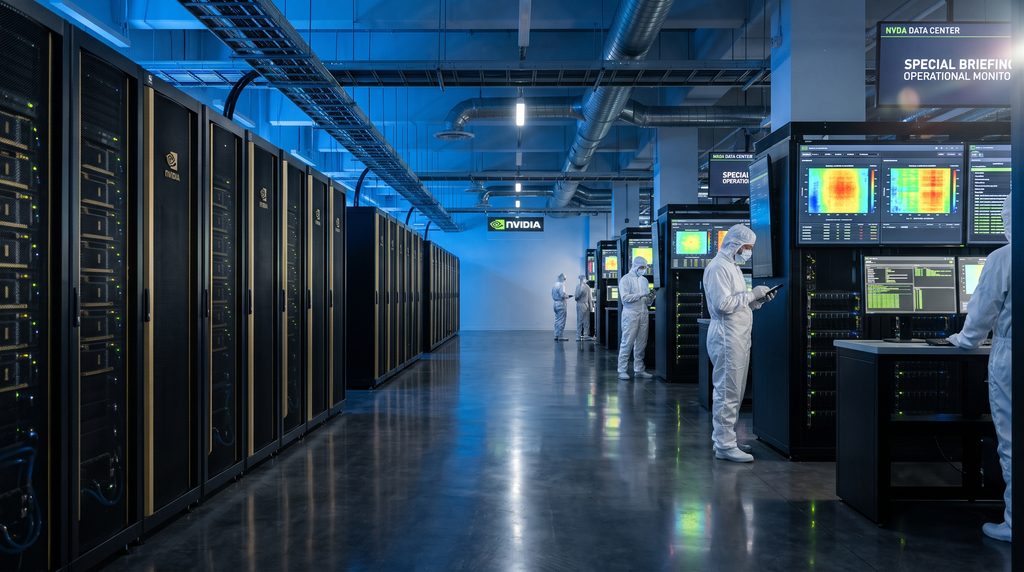
Beyond immediate quarterly earnings, the primary test for the Nvidia Life-After-Huang Briefing is reassuring investors that Nvidia’s technological roadmap will not lose momentum. For years, Jensen Huang personally presided over every architectural reveal, famously pulling new chips out of leather jackets at GTC keynotes.
With Huang sidelined, executive vice president of hardware engineering and chief scientist teams are stepping forward to prove that innovation at Nvidia is institutionalized rather than centralized:
- The Vera Rubin Transition: Scheduled for initial volume production rollout, the Vera Rubin architecture—featuring custom HBM4 memory stacks, advanced 2nm-class TSMC packaging, and centralized optical NVLink switches—is fully funded and moving through fabrication test tape-outs without delay.
- Diversifying Foundry Partnerships: To mitigate geopolitical supply-chain risks in Taiwan, Kress’s leadership team is actively coordinating with TSMC while evaluating secondary advanced packaging capacity in the United States and Japan.
To see how these next-generation processors are also being engineered for orbital data center deployment, read our exclusive feature on Orbital Data Centers (Internal Link).
4. Financial Guidance & Market Valuation Analysis (With Table)
How are institutional investment firms modeling Nvidia’s valuation following the leadership earthquake? Financial analysts evaluate the company’s investment risk using the Enterprise Value-to-Free Cash Flow ($\text{EV/FCF}$) valuation multiple and forward operating margin projections:
$$\text{EV/FCF} = \frac{\text{Market Capitalization} + \text{Total Debt} – \text{Cash}}{\text{Operating Cash Flow} – \text{CapEx}}$$
Following the Nvidia Life-After-Huang Briefing, Wall Street consensus estimates indicate that while short-term volatility and regulatory legal costs may compress the forward multiple from historical highs of $35\times$ down to a more conservative $14\times\text{–}18\times$, Nvidia’s phenomenal cash generation ($>$60\text{ billion}$ annual net income) provides an extraordinary financial safety net.
| Financial & Operating Metric | Pre-Resignation Peak (Oct 2026) | Post-Resignation / Briefing Outlook (Nov 2026) | Strategic Analysis & Market Status |
|---|---|---|---|
| Chief Executive Officer | Jensen Huang (Founder) | Colette Kress (Interim CEO) | Permanent Search Underway (Internal & External) |
| Q3 FY27 Revenue Guidance | $\sim $37.0\text{–}$39.0\text{ Billion}$ | On Track ($\sim $38.5\text{B}$ Consensus) | Strong Data Center GPU Shipments |
| Gross Profit Margin | $75.2%$ | $74.8\text{–}75.5%$ | Protected by Proprietary CUDA Moat |
| Forward P/E Multiple | $\sim 22\times$ | $\sim 12\times\text{–}14\times$ | “Founder Exit Discount” Compression |
| Vera Rubin Launch Status | On Schedule for 2027 | Confirmed Uninterrupted | Engineering Bench Operating Normally |
5. National Impact: What the Nvidia Life-After-Huang Briefing Means for Pakistan’s Tech Sector
How does an executive earnings briefing in Silicon Valley impact software engineers, university research labs, and technology businesses in Pakistan? From AI software houses in Lahore, Islamabad, and Karachi to academic supercomputing centers in Faisalabad and Peshawar, the Nvidia Life-After-Huang Briefing carries three vital implications for Pakistan’s digital economy:
1. Stability for Cloud GPU Availability and Pricing
Pakistani AI startups, deep-tech incubators, and university labs rely on cloud-hosted H100 and Blackwell GPU instances. Because Colette Kress confirmed that enterprise server allocations and supply-chain deliveries to global cloud partners remain unaffected, Pakistani developers can continue building large language model (LLM) fine-tuning pipelines and computer vision apps without fearing sudden hardware shortages.
2. Reinforcing Multi-Vendor AI Development Strategies
As global enterprise customers diversify their hardware stacks to mitigate single-vendor governance risk following Huang’s exit, Pakistani software export agencies that master cross-platform frameworks—such as PyTorch on AMD ROCm, OpenAI Triton, and Google Cloud TPUs alongside CUDA—will secure a distinct competitive advantage in international B2B contracting.
3. Educational Synergies with Enterprise AI Workflows
As local institutions train the next generation of engineers, combining hardware understanding with high-level agentic workflows—such as those explored in our guides on ChatGPT Business (Internal Link) and the Gemini 4 Hydrogen Launch (Internal Link)—ensures that Pakistan’s tech talent remains aligned with global enterprise standards.

Conclusion: Stability Amid Transformation
The Nvidia Life-After-Huang Briefing demonstrates that while losing a legendary founder is a profound psychological shock, a world-class engineering organization, massive enterprise demand, and an unassailable software ecosystem provide powerful structural stability. Under Interim CEO Colette Kress’s steady financial stewardship, Nvidia is proving that the artificial intelligence revolution is far bigger than any single individual.