
Global | November 16, 2026
Synology NAS ransomware attacks are targeting devices running outdated DiskStation Manager software, prompting the storage manufacturer to urge customers to install security updates immediately.
In an October 29 notice, Synology said attackers were exploiting a vulnerability patched in December 2024 to reach older DSM installations. The attacks aim to encrypt data and extort a ransom, according to the company.
The warning matters because a network-attached storage device can hold years of family photographs, business records, shared project files or backup copies. When that central device becomes unavailable, the disruption can spread far beyond a single computer.
Synology directed readers to an existing advisory covering several security issues. Its public statement did not identify the specific CVE being exploited, disclose an affected-device total or establish that every attack against a Synology product follows the same route.
Owners should check their installed DSM version, apply the latest supported update for their hardware and review whether the management interface is unnecessarily exposed. Anyone who finds evidence of an active compromise should prioritize containment and preserve recovery options before making major changes.
Synology NAS ransomware warning: what the company confirmed
Synology’s official ransomware warning says threat actors have targeted devices running outdated versions of DSM by exploiting a vulnerability for which a patch was available in December 2024.
The company says the attacks seek to encrypt data and demand payment. Its immediate recommendation is to update vulnerable versions and enable automatic updates so that DSM stays current.
The statement links to Synology-SA-24:20, an advisory originally published in November 2024 and updated as additional fixes and technical details became available. That link provides useful information about vulnerable branches, but it should not be treated as a public identification of one specific exploited flaw.
The warning also does not quantify the number of devices affected, name an attacker or describe every step the intruders used after gaining access. Those limits matter when owners assess the risk to their own systems.
The Hacker News reported on November 3 that customers had described infections associated with C3RB3R ransomware. Those reports provide context around the broader incident, but Synology’s short public notice does not itself attribute a named malware family or identify a particular CVE.
Why a storage appliance is an attractive target
A NAS is a specialized computer that stores files and makes them available over a network. It may serve several people at once, synchronize data with other devices or run applications such as photo libraries, media servers and backup software.
That convenience also concentrates risk. An attacker who can access files through a compromised storage device may affect shared resources used by multiple employees, household members or applications. The consequences depend on the permissions, services and data available in that environment.
A NAS is sometimes described as a backup simply because it contains another copy of a file. But a copy that remains online and writable by the same compromised accounts or device may be damaged during an incident. Whether it is recoverable depends on how the backup was designed and protected.
Synology NAS ransomware is therefore both a device-security issue and a recovery-planning issue. Updating the operating system reduces exposure to known vulnerabilities; separate, tested backups help limit the damage if another failure or attack occurs.
The risk is not limited to large companies. A small office may depend on a single device for accounting records and customer files, while a household may keep its only copy of important photos on a single shared volume.
What the linked DSM advisory actually says
The Synology-SA-24:20 advisory describes three vulnerabilities, with different affected components and potential consequences.
CVE-2024-10441 is rated critical in the advisory. Synology describes an output-encoding issue in the system plugin daemon that can allow remote attackers to execute arbitrary code on affected versions. The advisory does not provide a detailed public attack path.
CVE-2024-50629 concerns the webapi component and could allow remote attackers to read limited files. CVE-2024-10445 concerns certificate validation in the update functionality and could allow an adjacent man-in-the-middle attacker to write limited files.
These descriptions should not be combined into a single assumed attack chain. Nor does the advisory’s critical rating for one flaw prove that it was the specific weakness used in every observed ransomware incident.
Synology’s warning refers to a vulnerability patched in December 2024, while the advisory’s revision history records fixes for several branches in November 2024 and a DSM 6.2 update in December. Owners should rely on the applicable branch and fixed-release information rather than infer the attack mechanism from one date.
Synology NAS ransomware: check the full DSM version
The advisory lists fixed releases for several DSM branches. For DSM 7.2.2, it lists 7.2.2-72806-1 or later; for DSM 7.2.1, 7.2.1-69057-6 or later; and for DSM 7.2, 7.2-64570-4 or later.
It lists 7.1.1-42962-7 or later for DSM 7.1 and 6.2.4-25556-8 or later for DSM 6.2. These are the minimum builds listed for the linked advisory, not a promise that an old branch is protected against every later vulnerability.
The exact version and build number matter. A device labeled DSM 7.2.2, for example, can still be below the advisory’s fixed build. Administrators should check DSM’s update information and consult Synology’s current instructions for their specific model.
Install the latest supported release available for the device rather than stopping at an old minimum build when a newer supported security update is available. Compatibility and support differ by model; a device that cannot receive appropriate updates needs a separate risk-reduction and replacement plan.
The advisory also discusses Synology BeeStation OS in its vulnerability descriptions. This report focuses on Synology’s warning about outdated DSM installations and should not be read as a claim that the same ransomware campaign affected every product named in the vulnerability advisory.
After an update, verify that it installed successfully. Check installed packages and applications separately: updating DSM does not automatically prove that every third-party service on the device is current.
Reducing exposure without losing essential access
Synology NAS ransomware risk is influenced by more than a version number. Owners should inventory where the device can be reached, who can sign in and which services are enabled.
Avoid exposing the DSM management interface directly to the public internet when that access is unnecessary. Review router port-forwarding rules, automatic forwarding settings and remote-access services. A management interface believed to be internal may still be reachable through an old router rule.
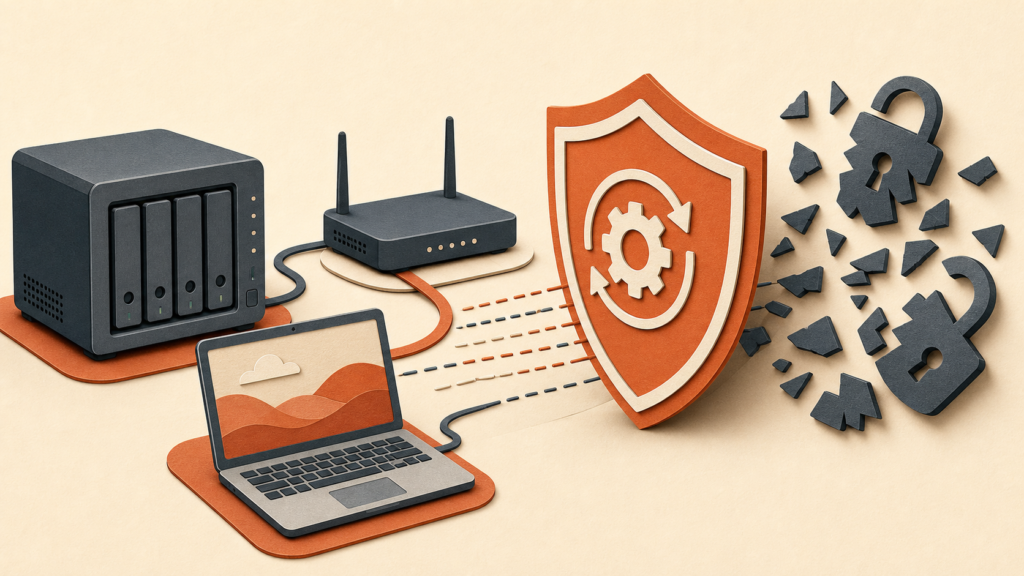
If remote administration is necessary, use an organization-approved, securely configured remote-access method and restrict access to authorized users. A VPN or access gateway also requires patching and monitoring; it is not a substitute for updating the NAS itself.
Remove or disable unused accounts and services, use unique passwords and enable multifactor authentication where supported. Limit administrative privileges and review file-share permissions so ordinary users and applications receive only the access they require.
Network segmentation can reduce unnecessary access between the NAS and other systems. Test any changes carefully: backup jobs, synchronization and legitimate remote workflows may rely on existing routes or service accounts.
These measures add layers of protection, but none should be described as a guaranteed workaround for the vulnerability mentioned by Synology. The linked advisory lists no mitigation in place of applying the fixed software.
Backups should survive the device they protect
A practical response to Synology NAS ransomware includes checking whether important data exists somewhere other than the affected appliance. A backup plan should account for accidental deletion, hardware failure and malicious encryption, not only the current warning.
Keep at least one recovery copy isolated or otherwise protected from routine write access. Depending on the environment, that can mean an offline external drive, a separately administered backup destination or a service with appropriately configured immutable retention.
A second copy on the same NAS may not provide meaningful isolation if the same device, administrator account or storage pool can modify both copies. Snapshots can be valuable, but their protection depends on configuration, privileges, retention and whether an attacker can delete or alter them.
Test restoration using representative files and, where needed, application data. An untested backup may be incomplete, corrupted or missing the credentials and configuration needed for recovery.
The NewsFlayer report on the Beget cyberattack illustrates a separate incident in which infrastructure damage and backup availability created recovery challenges. It is not part of the Synology attacks, but it underscores the need to understand where copies are stored and who can change them.
If files are already encrypted
If a device shows signs of compromise, such as unexpectedly encrypted files or a ransom message, disconnecting it from exposed networks can help contain further activity. Coordinate that step with an incident-response professional when the device supports critical operations.
Avoid immediately wiping the system, deleting logs or repeatedly rebooting it. Those actions can destroy useful evidence or recovery opportunities. The appropriate preservation steps depend on the circumstances, so seek qualified assistance before making irreversible changes.
Identify connected computers, shared folders and backup destinations that may also have been exposed. Isolate or protect backup copies from further modification, and investigate access paths before reconnecting systems.
Patch vulnerable software as part of a broader recovery plan, but do not assume that installing an update removes malware or reverses unauthorized changes. Responders may need to examine accounts, scheduled tasks, applications, network settings and other indicators of persistence.
Before restoring data, assess whether the backup is clean and whether the destination has been rebuilt or otherwise verified. Restore in a controlled manner and monitor for renewed suspicious activity.
A ransom note does not prove data was stolen, and the absence of a public claim does not prove it was not. The Synology statement reviewed here confirms encryption and extortion as attackers’ aims, not a universal data-theft outcome for all affected owners.
What remains unknown about the campaign
Public reporting about Synology NAS ransomware contains different descriptions of possible entry points. Security researchers may investigate different victims or attack clusters, and an observed weakness in one case should not automatically be assigned to all others.
The manufacturer has not publicly specified the CVE used in the attacks described by its October notice. It also has not published an affected-device count in that statement. Claims about the total number of victims, a universal decryptor or an unpatched zero-day require their own reliable evidence.
The distinction is especially important when a vendor advisory lists multiple vulnerabilities. A reader can use the advisory to determine which updates are relevant without claiming that each listed issue was exploited in the ransomware activity.
For administrators, the uncertainty does not justify inaction. Apply supported updates, reduce unnecessary exposure, confirm that recovery copies work and investigate signs of compromise. Those steps address the known warning while leaving room for future findings to refine the picture.

Conclusion
The Synology NAS ransomware warning shows how an older, patched vulnerability can remain consequential when devices continue running outdated software. Synology confirmed attacks aimed at encrypting files and extorting payment, but did not identify the exploited CVE in its public statement. Owners should update supported DSM installations, review internet exposure and maintain independently protected, tested backups while treating any suspected compromise as an incident requiring investigation.
Source Note: Synology ransomware warning; Synology security advisory SA-24:20; The Hacker News reporting.
NewsFlayer — Bringing You the Latest Cybersecurity News from Around the World.