Global News | November 12, 2026
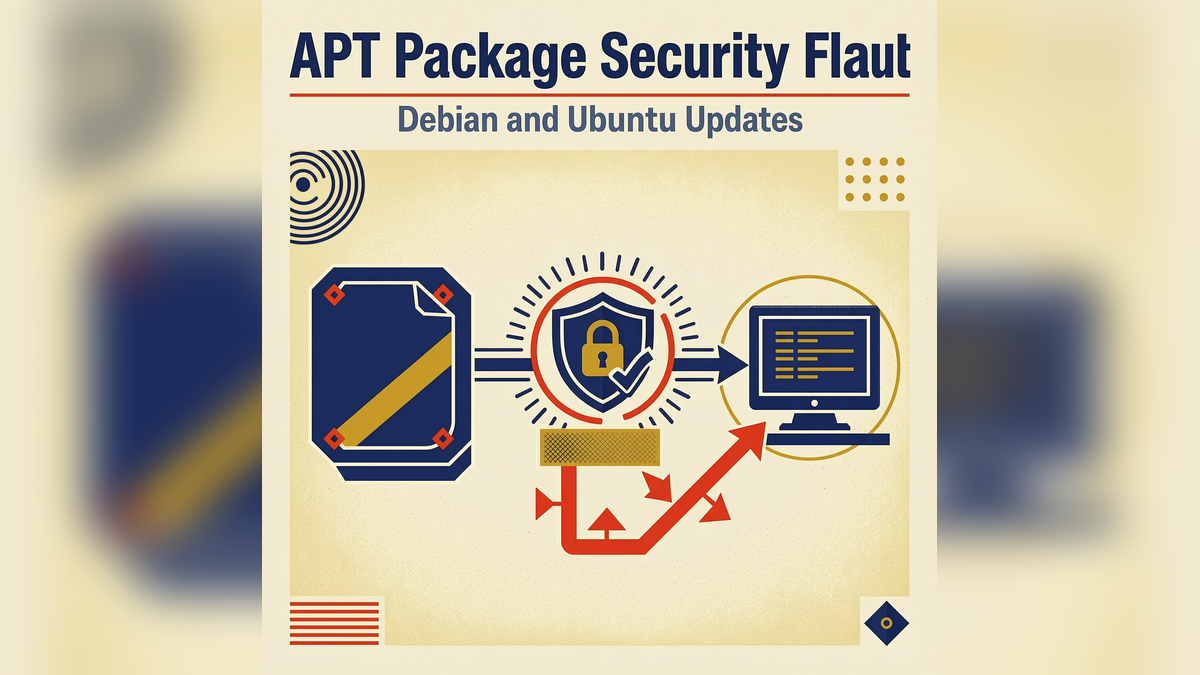
The APT vulnerability could allow an attacker positioned on the package-download path to install an unverified package with root privileges. APT is the software package manager used by Debian, Ubuntu and derivative Linux distributions.
Tracked as CVE-2026-109518, the issue involves the handling of downloads when redirects and retries occur. Ubuntu says an attacker able to manipulate HTTP traffic between an APT client and an archive server—including through a malicious mirror or proxy—could cause the client to install an attacker-controlled package.
APT developers describe the issue as a critical file-verification bypass. Ubuntu rates it high priority, with a CVSS version 4.0 base score of 7.7. Debian and Ubuntu have published fixed package versions, although the appropriate update depends on the distribution and release.
The advisories reviewed for this article describe a possible attack under specific conditions; they do not establish that any particular organization was compromised. Administrators should identify affected installations, obtain updates through trusted channels and verify that the correct vendor-fixed version is installed.
A Package Manager’s Trust Boundary
APT is used to retrieve and install software packages on Debian and Ubuntu systems. It appears in environments ranging from personal computers and hosted servers to container images and automated build pipelines.
The APT vulnerability concerns the relationship between package verification and the handling of downloaded files. APT developers say an attacker could combine redirects with transient HTTP server errors that cause retries, leading APT to overwrite existing hard links with an attacker-chosen payload.
Ubuntu says the result can be installation of an unverified, attacker-controlled package. Because Debian packages are installed with root privileges, successful exploitation can result in code execution with those privileges.
That is a serious potential outcome, but it is conditional. The advisory describes an attacker who can manipulate the relevant HTTP traffic, a package installation and a specific download-handling path. It does not say that simply having APT installed gives an arbitrary internet user root access.
The Role of Redirects and Retries
According to the APT developers’ November 4 security update, the issue depends on APT retrying downloads. The relevant setting is Acquire::Retries, which must be nonzero for the described attack path.
The developers say retry behavior has been enabled by default since APT 2.3.2. Ubuntu states that a value of three is the default starting with Debian 12 and Ubuntu 22.04 LTS. Older releases are not affected in their default configuration, according to Ubuntu, but custom scripts or configuration may have enabled retries.
A redirect tells a client to retrieve a resource from another location. A retry occurs after a temporary failure. In the reported flaw, those ordinary download behaviors interact with the reuse of hard links in a way that can undermine the verification boundary.
The vendor descriptions do not establish that every redirect or failed download is malicious. Administrators should assess their package version, effective configuration and download environment together rather than interpreting a single retry as proof of an attack.
The Attacker’s Position Matters
Ubuntu describes an on-path attacker able to manipulate the HTTP traffic between the client and archive server. It includes a malicious mirror or proxy as examples of positions from which traffic could be manipulated.
An attacker in that position might control or interfere with the content or behavior delivered during a package download. Successful exploitation also depends on the vulnerable APT code path and its retry configuration. The disclosed mechanism is not a generic vulnerability in every software repository or package signature system.
The sources describe the attack over HTTP. They do not establish a universal guarantee that HTTPS alone protects every relevant deployment or redirect arrangement. Encrypted transport is useful defense in depth, but it should not be treated as a substitute for the vendor-provided APT fix.
APT’s normal verification protections remain important. The specific problem is that the documented file-handling sequence can allow the package installed to differ from what the client’s verification process was intended to protect.
Debian’s Fixed Package Versions
Debian’s security tracker identifies fixed versions for its supported release branches:
- Debian 12, bookworm: APT 2.6.2 in the security repository.
- Debian 13, trixie: APT 3.0.4 in the security repository.
The tracker also listed fixed packages for the testing and unstable branches when reviewed. Those branches change frequently, so administrators should consult the live Debian security tracker and package repository rather than relying on a static snapshot.
A package version should be compared in the context of its distribution and release. Debian and Ubuntu often maintain their own security fixes and version suffixes; a simple comparison with an upstream version number may not accurately show whether a distribution package is fixed.
APT developers also announced fixes for several maintained upstream series. Availability through a particular Debian support channel depends on the release and support arrangement. Operators of older or unsupported systems should check their applicable long-term or extended-support provider.
Ubuntu’s Fixed Package Versions
Ubuntu’s CVE page lists the following fixed builds for currently listed releases:
- Ubuntu 22.04 LTS: 2.4.15ubuntu0.1.
- Ubuntu 24.04 LTS: 2.8.4ubuntu0.1.
- Ubuntu 26.04 LTS: 3.2.1ubuntu0.1.
- Ubuntu 26.10: 3.3.3ubuntu0.1.
Ubuntu also lists fixed packages for several older LTS releases with extended security maintenance version suffixes. Availability can depend on Ubuntu Pro or another applicable support entitlement. Administrators should check the vendor’s current release-specific status and enabled repositories before assuming a fix is available to a particular machine.
The APT vulnerability affects a package-management component, not a single application. Updating a server’s application alone will not necessarily update APT, and upgrading one host does not automatically update the container images or build environments it uses.
A November Security Disclosure
The APT developers published their security update on November 4 and credited researcher Max Justicz with reporting the issue. The update describes CVE-2026-109518 as a file-verification bypass and also discusses other fixes bundled into the release.
Debian’s security tracker identifies fixes for bookworm and trixie, while Ubuntu publishes a security notice and release-specific package status. Those sources should be used for current versions and support information because repository contents and tracking pages can change.
The other fixes discussed in the APT developer announcement should not be conflated with the package-replacement issue. Some concern memory-handling or denial-of-service scenarios, and the developers describe their expected impact separately.
The public advisories reviewed do not provide a verified number of victims or a named campaign exploiting this CVE. That absence should not be interpreted as proof exploitation has never occurred; it means the reporting available here does not substantiate such a claim.
Assessing Exposure Across an Organization
Start by identifying Debian, Ubuntu and derivative systems that install or update packages using APT. Include internet-facing servers, developer workstations, cloud instances, virtual-machine templates, containers and continuous-integration runners.
For each environment, record the distribution release and installed APT package version. Compare the result with the relevant vendor’s fixed build, accounting for distribution-specific versioning and any extended-support channel.
Administrators should also review the effective retry configuration and package-download routes. Older systems that do not enable retries by default may still be exposed if a script or local configuration changes the setting. Conversely, the conditions in the advisory should not be assumed to apply identically to every custom environment.
Pay particular attention to systems that obtain packages through shared mirrors, proxies or build infrastructure. A single service may feed many machines, although the presence of a proxy alone is not evidence that it has been compromised or can be manipulated by an attacker.

Updating APT Safely
Use the distribution’s official security guidance and trusted repositories to install the appropriate fixed APT package. Confirm repository configuration and the integrity of the update path before making changes, particularly if a mirror or proxy is suspected of compromise.
A routine update over a network path believed to be actively manipulated may itself involve risk. In that situation, consult the distribution vendor or an experienced responder about an independently verified package and a trusted recovery method rather than relying on the suspicious path.
After updating, verify the installed package version against the vendor’s release-specific fixed version. Retain the evidence in change records and check that package-management services and application deployment workflows continue to operate normally.
Do not assume that switching mirrors, enabling HTTPS or disabling retries is a vendor-approved replacement for the security update. The sources reviewed identify patched packages as the primary remedy; any temporary operational restrictions should be assessed with the vendor and security team.
Containers, Images and Build Pipelines
A patched host does not automatically change an existing container image. Teams should identify base images containing APT, rebuild them with an appropriately fixed package and redeploy workloads according to their operating procedures.
Similarly, a newly rebuilt image does not automatically replace every running container or old image stored in a registry. Track deployment status and verify the package version in the image that actually runs.
Continuous-integration systems may repeatedly install packages during builds. Review runner images, cache policies, package mirrors and proxy configuration. A build environment can propagate software artifacts to other systems, so its update path deserves the same attention as a production server.
These are exposure-management recommendations, not evidence that the reported vulnerability was used to compromise a particular build pipeline. Organizations should investigate their own environments if they have reason to suspect manipulation.
Responding to Suspected Tampering
If administrators observe credible signs that a package source, proxy or download path was manipulated, preserve relevant logs and involve an incident-response team. Investigate which machines installed packages through the suspect route and during what period.
Review package-management history and available network records, but recognize their limitations. A lack of visible errors or an apparently successful installation does not independently prove that no tampering occurred, and a retry alone does not prove compromise.
If a malicious package ran with root privileges, recovery may require more than installing the fixed APT package. Responders should assess the machine’s trustworthiness, the scope of access and any exposed secrets, then choose containment, rebuilding and credential-rotation steps based on the evidence.
A Broader Supply-Chain Lesson
The APT vulnerability highlights a distinction between the authenticity of package metadata and the integrity of every step that handles files before installation. An attacker who can interfere with an intermediate step may seek to cross a trust boundary even when a verification feature exists.
That does not mean signed repositories are ineffective or that package verification should be disabled. It reinforces the need to maintain the package manager itself, protect infrastructure around it and verify that updates reach all relevant hosts and images. The separate cPGuard update-channel compromise illustrates another way trusted software distribution can be abused.

Conclusion
CVE-2026-109518 could allow an on-path attacker to cause a vulnerable APT client to install an unverified package with root privileges under the conditions described by Ubuntu and the APT developers. Fixed packages are available for the Debian and Ubuntu releases listed in their advisories.
Administrators should inventory their systems, use trusted update paths, confirm the correct distribution-specific fixed version and rebuild affected images. The sources reviewed do not establish a victim count or a confirmed campaign.
Source note: This article draws on the APT developers’ November 4 security update, Debian’s security tracker and Ubuntu’s CVE page and security notice. NewsFlayer has not independently reproduced the vulnerability or verified attacks against individual systems.
NewsFlayer — Bringing You the Latest Cybersecurity News from Around the World.